Global Investors Adjust India Portfolios as Market Signals Diverge
According to Whalesbook reporting, multinational corporations are navigating a market where regulatory approvals and revenue surges coexist with logistics route cancellations, credit tightening, and…
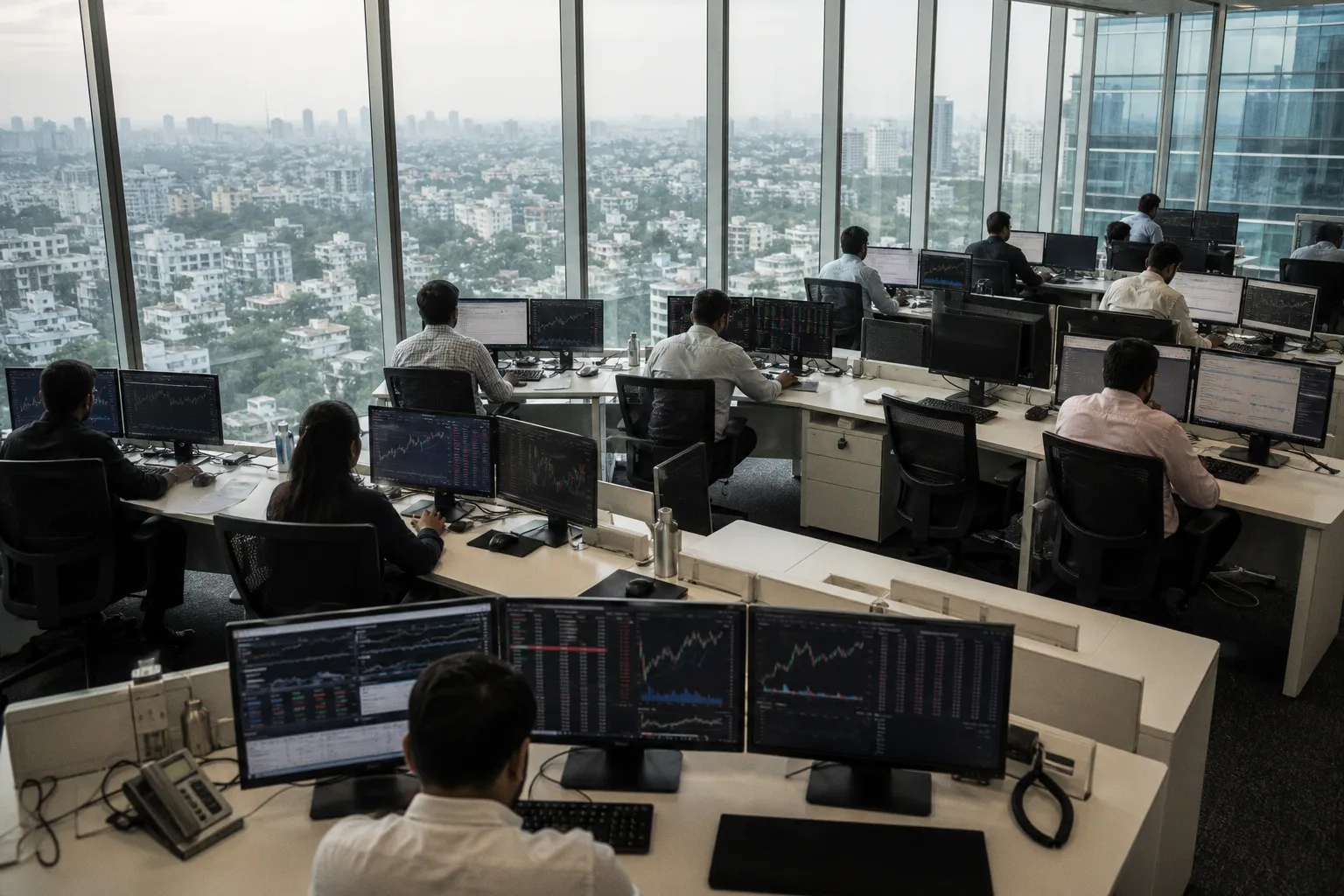
Global firms are recalibrating India strategies as capital deployment meets divergent sector signals. According to Whalesbook reporting, multinational corporations are navigating a market where regulatory approvals and revenue surges coexist with logistics route cancellations, credit tightening, and moderating commercial vehicle demand — a mix that demands closer underwriting scrutiny from LPs tracking emerging-market exposure.
Capital Allocation Splits Across Verticals
Medical technology presents the clearest regulatory tailwind. A robotic surgery specialist has secured approval for its da Vinci 5 platform in India and is reporting sustained growth in procedure volumes, positioning the firm to scale within premium healthcare. The addressable market is expanding: the physical AI sector alone is projected to grow from a USD 0.89 billion base to USD 15.24 billion by 2032 at a 47.2% CAGR, per MarketsandMarkets, driven by edge computing, multimodal perception, and autonomous robotics deployment.
Electronics manufacturing is generating comparable top-line momentum. One global enterprise networking firm reported a near-doubling of India revenue and is evaluating a potential manufacturing partnership with the Adani Group for AI-related infrastructure — though the project remains in discussion phase with no finalized agreement. For allocators, the absence of a binding term sheet means the IRR thesis is contingent on execution risk that cannot yet be priced into comparable transaction multiples.
Supply Chain Stress and Working Capital Discipline
Logistics headwinds are compressing margins downstream. A major global logistics provider has reported cancellation of key shipping routes to North America, resulting in cargo accumulation and equipment shortages that could impair export timing for Indian portfolio companies reliant on those corridors. Any GP with exposure to India-linked manufacturing or export-oriented distributors should model extended days-sales-outstanding into base-case cash flow assumptions.
Agricultural science is signaling defensive posture independently. A leading firm in the sector has implemented tighter credit policies, prioritizing receivable collection and shifting certain segments to a cash-only model — a working-capital restructuring that points to elevated competitive intensity and potential customer concentration risk. Commercial vehicles, meanwhile, are showing moderating momentum; infrastructure-led heavy-duty demand persists, but the rapid expansion phase is stabilizing, suggesting a flatter capex cycle ahead.
Selective Deployment, Elevated Risk Premia
Investment funds have broadly moved toward a neutral weighting on India, treating recent market corrections as incremental accumulation windows while maintaining caution on the country's structural oil-import dependency during periods of geopolitical disruption. Meanwhile, radiation therapy operators are piloting hub-and-spoke models to extend reach into underserved markets — a capital-light distribution approach that lowers per-unit treatment cost but introduces coordination risk across decentralized sites.
For institutional allocators, the current India environment demands vertical-specific diligence rather than broad EM beta exposure. The dispersion between capital-light digital-health and AI-infrastructure plays on one side, and logistics-disruption-exposed, credit-tightening-affected sectors on the other, warrants a granular assessment of covenant structures and downside protection mechanisms before committing incremental tranche capital.